Archive for new day
Up

Part of my mindfulness practice these days is paying attention to acts that make me happy.
I have found that for this flâneur, looking straight up while walking around fills his sensorium with delight and gratitude.
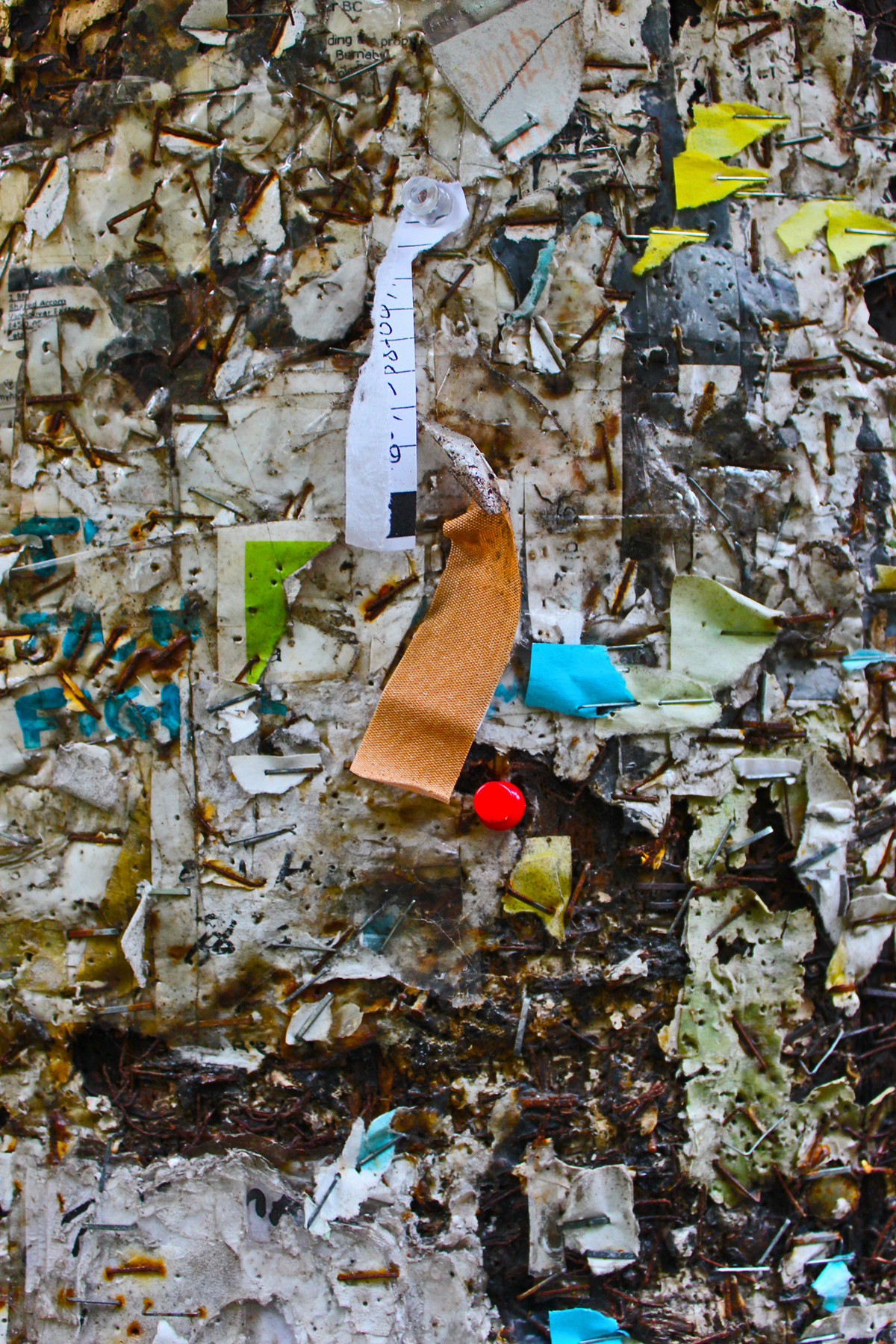
(The picture above and the others in the new batch – click on the pic – were taken on Burnaby Street in Vancouver, a few blocks from English Bay.)


My university
You can now study the cultivation and marketing of (“medical”) marijuana at Kwantlen Polytechnic University. Wow (and how British Columbia!).


A puzzle
Were I the mayor of a sizeable United States city – one that has a large African American population – I would be on the air-waves or travelling my city by foot and car assuring my constituents that I and other city officials will be improving relations between that population and the police starting right now. Were I the governor, I would be in that city promising job programs and infrastructure creation. If, as I expect, the six officers involved in killing Freddie Gray – that black young man from West Baltimore – are exonerated (or even partially exonerated) by an upcoming police report, there will be violence across the nation, with not just rocks and bricks but with bullets and bombs.
But where are they? Why, at this late date, are these mayors and governors not in their own streets working to mitigate the profound destruction likely to arrive in but a couple of days?
Yik Yak and Meerkat
When Ted Cruz announced his candidacy for USA president at Liberty University yesterday, many students in the audience used the Smartphone app Yik Yak to mock the junior senator from Texas (and to complain that they were coerced to attend the event by the university). Yik Yak gives users the opportunity to interact anonymously with other users within a ten-mile radius. The tone of the messages run the gamut; many are vile indeed (no examples needed here); others are requests for advice (“where’s a good place for lesbians to drink on Granville Street?”); and others are semi-amusing insults (“Things I love more than you: burritos”). I will keep this app on my iPhone for a few days to find out if there is anything I find there that I can’t find elsewhere. If so, it stays. I have my doubts.
Another recent addition to my iPhone will stay there a long time: Meerkat, a very simple live-streaming application; I have been looking for something like this for a long time. My first project: Live-streaming (some of) my Kwantlen classes.
[April 11 *Update*: Yik Yak has been true to its name, mostly icky chatter; it’s off my iPhone. Meerkat’s groundbreaking appearance did not lead to long-term dominance; Periscope, purchased by Twitter, has supplanted Meerkat almost completely. Things change very fast in app-land. That’s why teaching my digital marketing class is such a challenge, and usually very fun, too.]

The Canadian Arachnoid Cyst Foundation website’s up
With the help of two students from my upper-level Technical Report Writing class this summer, last week Garry Hicks launched an important new website devoted to spreading awareness of Arachnoid cysts and to helping out those who are suffering with them. It is an honour to be a part of this initiative in its early going.

Garry Hicks
Simpleness
My recipe for making people happy:
- Tell parents that their infant is beautiful.
- Tell neighbors that their dog is beautiful.
- Tell little children that their bikes are fantastic.
—-
Facebook friends append some ingredients to my recipe:
- “Little kids also like to know that you love their sneakers.” (thanks to S. M.)
- “Also, tell them their lemonade is good. Buy a second cup.” (thanks to @bfwriter)
Very Cool Project

A super-talented Kwantlen Polytechnic University student of mine is helping his friend establish The Canadian Arachnoid Cyst Foundation. From its GoFundMe website:
We are raising money to build the Canadian Arachnoid Cyst Foundation. The Foundation has three main goals:
- To establish a support group to assist in the daily affliction of living with an arachnoid cyst, where moral support, advice, and personal relationships are offered;
- To accept donations and issue grants to assist in the financial burden of living with an arachnoid cyst, to help cover medication and/or surgery costs;
- To raise awareness within the Canadian medical community of the problems that arachnoid cysts do indeed cause.
Surprisingly little is known about arachnoid cysts, and doctors have, for the great majority, been educated that these are ‘asymptomatic’, and do not cause problems. Despite the overwhelming number of people with arachnoid cysts which are dismissed as an ‘incidental finding’ on MRI or CT scan, they all seem to present the same issues, symptoms, and affliction – depending on the area of the brain these cysts sit on, one or more functions of the brain can become impaired. …
Many people get turned away from the ER, told that they are or will be fine, go on to have many many more problems, and it is the Foundation’s mission to save people with arachnoid cysts years and years of needless suffering by having patients properly treated and attended to in a dignified manner. …
What we are looking for to get started is not much. Our budget includes our cost to get started, pay for the smallest amount of legal help we can, help the Foundation become a legal entity, and get started gathering donations and grants, so that we may issue help to people who are badly in need, and otherwise unable to get the assistance they need, in the time frame they need it.
The calamities are coming …
The future American class war:
Wealthy Seattle entrepreneur Nick Hanauer warns his “fellow zillionaires” that “the pitchforks are coming for us plutocrats.”
At the same time that people like you and me are thriving beyond the dreams of any plutocrats in history, the rest of the country—the 99.99 percent—is lagging far behind. The divide between the haves and have-nots is getting worse really, really fast. In 1980, the top 1 percent controlled about 8 percent of U.S. national income. The bottom 50 percent shared about 18 percent. Today the top 1 percent share about 20 percent; the bottom 50 percent, just 12 percent.
But the problem isn’t that we have inequality. Some inequality is intrinsic to any high-functioning capitalist economy. The problem is that inequality is at historically high levels and getting worse every day. Our country is rapidly becoming less a capitalist society and more a feudal society. Unless our policies change dramatically, the middle class will disappear, and we will be back to late 18th-century France. Before the revolution.
And so I have a message for my fellow filthy rich, for all of us who live in our gated bubble worlds: Wake up, people. It won’t last. …
The thing about us businesspeople is that we love our customers rich and our employees poor. So for as long as there has been capitalism, capitalists have said the same thing about any effort to raise wages. We’ve had 75 years of complaints from big business—when the minimum wage was instituted, when women had to be paid equitable amounts, when child labor laws were created. Every time the capitalists said exactly the same thing in the same way: We’re all going to go bankrupt. I’ll have to close. I’ll have to lay everyone off. It hasn’t happened. In fact, the data show that when workers are better treated, business gets better. The naysayers are just wrong.
Most of you probably think that the $15 minimum wage in Seattle is an insane departure from rational policy that puts our economy at great risk. But in Seattle, our current minimum wage of $9.32 is already nearly 30 percent higher than the federal minimum wage. And has it ruined our economy yet? Well, trickle-downers, look at the data here: The two cities in the nation with the highest rate of job growth by small businesses are San Francisco and Seattle. Guess which cities have the highest minimum wage? San Francisco and Seattle. The fastest-growing big city in America? Seattle. Fifteen dollars isn’t a risky untried policy for us. It’s doubling down on the strategy that’s already allowing our city to kick your city’s ass.
—–
The future world:
In The New York Review of Books, Bill McKibbon says it is no longer “if” but “when” climate change will ruin our world.
Human effects on the atmosphere and climate can actually be read more easily from the South Pole than almost anywhere on earth, and the results are truly horrifying. To put the facts simply, the massive ice sheets are starting to move with awful speed. On the narrow Antarctic Peninsula, which points up toward South America, and where most Antarctic tourists come, melt is proceeding as fast as or faster than anywhere on earth. It’s here that a big chunk of the Larsen B ice shelf broke off in 2002.
But the peninsula contains relatively small amounts of ice; most of the world’s freshwater is tied up in the giant ice sheets of East and West Antarctica. Scientists—innately conservative—had long considered that these giants were comparatively stable, at least over millennia: it’s no easy feat to melt a mile or two of ice, especially when the air temperature rarely if ever rises above freezing. However, as Walker hints toward the end of her account, researchers have grown increasingly concerned about the stability of the West Antarctic in particular.
Enormous glaciers spill out from the West Antarctic ice sheet into the Amundsen Sea in the South Pacific. It’s perhaps the most remote part of the most remote continent, and to make matters worse the most interesting part of it is underwater. So scientists have been sending “autonomous subs” beneath the waves to study the geology, and using satellites to study changes in the height of the ice. Their work wasn’t quite finished when Walker went to press with her book, but her account provides all the background you need to understand what may have been the most depressing announcement yet of the global warming era.
In mid-May of this year, a pair of papers were published in Science and Geophysical Research Letters that made clear that the great glaciers facing the Amundsen Sea were no longer effectively “buttressed.” It turns out that the geology of the region is bowl-shaped: beneath the glaciers the ground slopes downward, meaning that water can and is flooding underneath them. It is eating away at them from below and freeing them from the points where they were pinned to the ground. This water is warmer, because our oceans are steadily warming. This slow-motion collapse, which will occur over many decades, is “unstoppable” at this point, scientists say; it has “passed the point of no return.”
This means that as much as ten feet of sea-level rise is being added to previous predictions. We don’t know how quickly it will come, just that it will. And that won’t be all. A few days after the Antarctic announcement, other scientists found that much of Greenland’s ice sheet shows a similar underlying geology, with warm water able to melt it from underneath. Another study that week showed that soot from huge forest fires, which are more frequent as a result of global warming, is helping to melt the Greenland ice sheet, a remarkably vicious cycle.
In certain ways none of this really comes as news. A leading glaciologist, Jason Box of the Geological Survey of Denmark and Greenland (GEUS), has calculated that given the paleoclimatic record, our current atmospheric levels of greenhouse gases are probably enough to produce an eventual sixty-nine feet of sea-level rise. But it’s one thing to know that the gun is cocked, and another to see the bullet actually traveling; the news from the Antarctic is a turning point. It doesn’t mean we should give up efforts to slow climate change: if anything, as scientists immediately pointed out, it means we should ramp them up enormously, because we can still affect the rate at which this change happens, and hence the level of chaos it produces. Coping over centuries will be easier than coping over decades.
Kwantlen to Open Campus #5

My fine university made a big announcement today. Here is the school’s news release:
Kwantlen Polytechnic University (KPU) will expand its commitment to the region south of the Fraser with a 30,000 square foot (almost 2,800 square metre), three-storey site dedicated to professional development, business and innovation at 3 Civic Plaza in Surrey City Centre.
President and Vice-Chancellor Dr. Alan Davis announced today that KPU plans to reinvigorate the educational experience in Surrey with a roster of new programs that meet the needs of industry, business and professionals in Metro Vancouver’s latest downtown core.
“Kwantlen was born from the need to provide relevant post-secondary education to the South Fraser Region. For the past 32 years, we have grown to serve more than a quarter of a million students. But KPU’s vision is to be bigger, bolder and better. KPU Civic Plaza is just that,” said Davis.
Expected to open early 2016, KPU Civic Plaza plans to deliver professional studies, upper-level business courses and post-graduate credentials in downtown Surrey, from a location with excellent transit and SkyTrain access, on a hotel and residential site that can accommodate professionals from throughout the region.
The centre is also envisioned to become a hub for community engagement, collaboration and connection between researchers and Surrey’s health and technology sectors on Innovation Boulevard. From City Centre, KPU will lead the landscape of urban education, championing the entrepreneurial spirit that has led Surrey to become the largest city in Metro Vancouver, and the second largest in the province.
“With one-third of Surrey’s population under the age of 19, the new KPU Civic Plaza is an excellent example in how the City of Surrey is reaching out to meet the needs of our future leaders,” said Mayor Dianne Watts. “Once complete, the KPU Civic Plaza will begin by bringing more than 1,600 students each year into our downtown core, which falls in line with the City’s vision for the area. I like to welcome the students and staff of Kwantlen Polytechnic University to the heart Surrey City Centre.”
KPU Civic Plaza will expand on the traditional academic day and year, with community-oriented, short-term and direct professional development programming to be offered throughout the entire calendar year – on weekdays, evenings and weekends. Initially, Surrey’s largest and longest-serving university will accommodate over 1,600 students in a district filled with companies charging the city’s business, economic and social sectors.
“KPU is a perfect fit with 3 Civic Plaza. I can already imagine the students adding to the sense of community. KPU will be at centre ice of the new City Centre,” said Sean Hodgins, President of Century Group, the developer behind Surrey City Centre’s iconic plaza.
Proposed programs include graduate diplomas and certificates in: strategic planning, media and communications, public relations, emerging markets analysis, product development, management sciences, accounting, human resource management, financial analysis, specific business applications, and professional standards.
Kat

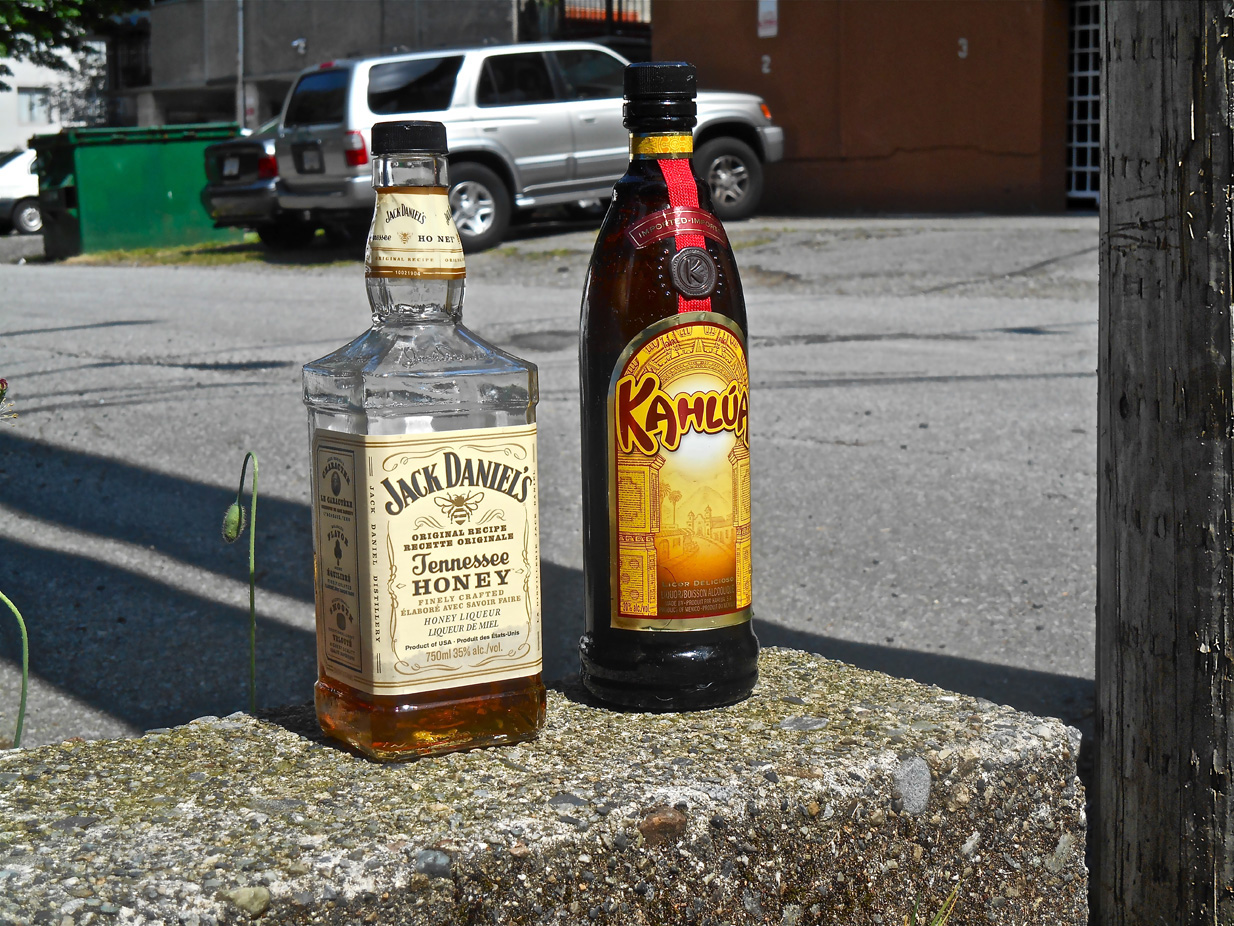
A very serendipitous moment: A combination of my obnoxious insistence and Kat‘s natural, 3-in-the-morning grace. La!
A long commute
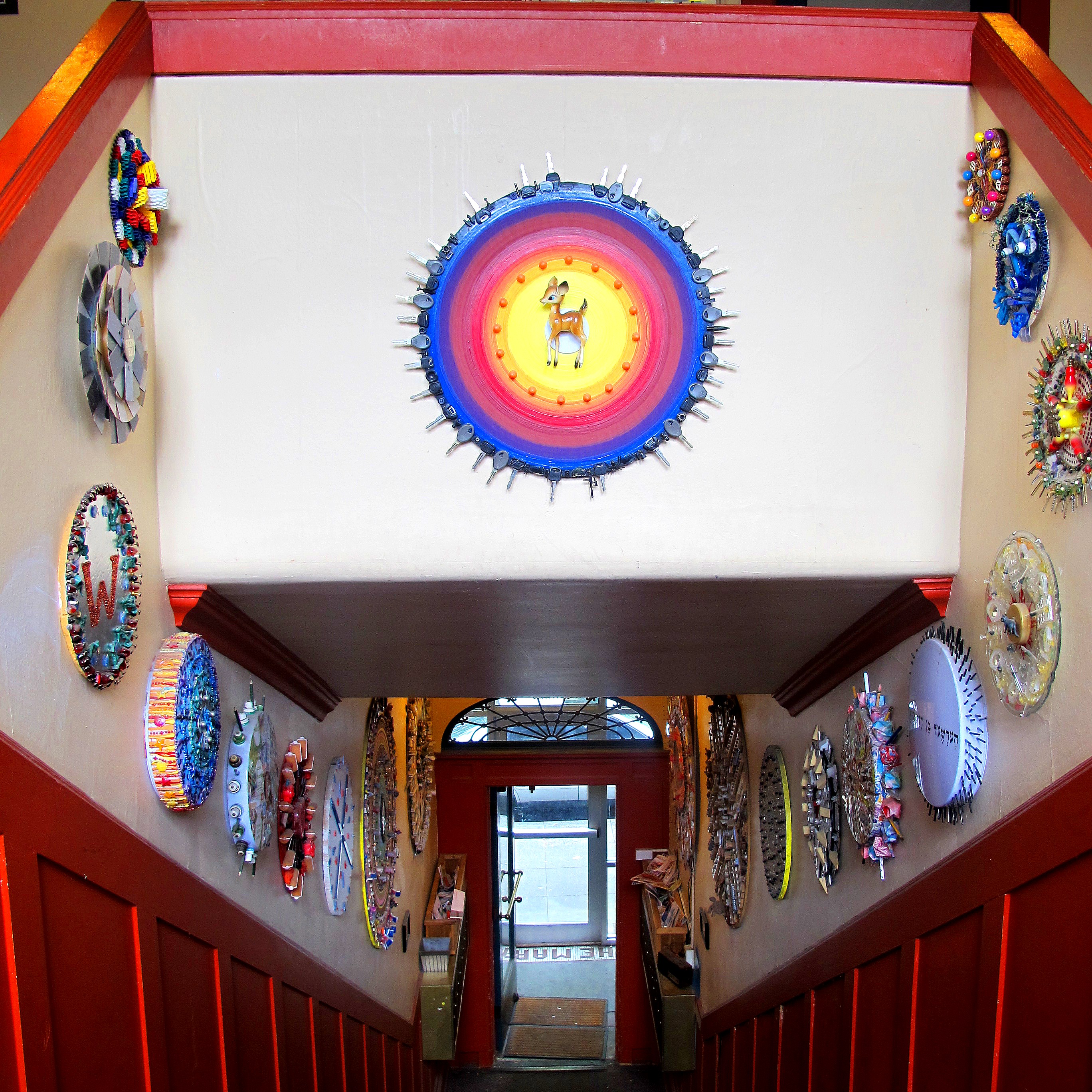
This summer I’m back at The Martin Building in Olympia, WA. It’s a long commute up to Surrey, BC, for my Tuesday afternoon and evening classes at Kwantlen, but I couldn’t be happier to be here.

But that would be rude.
I was an extrovert until April 20, 1992. That was the day after Easter. I resigned from my position as Senior and Acquisitions Editor at Prometheus Books Inc. on that day and began a journey that took me from Buffalo’s East Side, to New York City, and then to Stanford University, and, at last, to Vancouver.
I spent that Easter in Toronto. I was there to appear on a 90-minute-long talk & debate show on CBC TV on behalf of Prometheus Books and its two sister organizations (here and here). I don’t actually remember what the topic was but guess, since this was Easter, it was “Near Death Experiences,” often a popular subject during the Easter season back in the day. After the show, which was exhausting, I went out into the city, which was dead, so I bought a dozen or so magazines and returned to my hotel and had some drinks from the mini-bar and read for hours. Back in Buffalo the next day, I cleared out my office after the business manager at Prometheus rejected my expense report, saying it exceeded the allowable per diem. I became an introvert the moment I left the building, and never went on television or did a radio interview again.
Back in New York City a few weeks ago, I went to a bar in Little Italy to have a shot of tequila and a beer while waiting for my sister Jenny to swing by the neighborhood for dinner. I’d hardly sipped some tequila when a fellow at the bar started talking to me about how a wife can now track her husband via the GPS in his cell phone and see what he’s doing, live, online, because web-cams are used in all the bars now. “No kidding!” I said. The bartender joined the conversation with a funny wife-with-GPS story. A woman got up from her table and came to the bar with her own tale. Within seconds, it seemed, seven or eight of us were engaged in loud, intense and very fun conversation. When I got up to leave, to meet my sister, my new friends offered to buy me another round to get me to stay. That sure was tempting.
I left that bar feeling strangely great, and not just Cuervo Gold strangely great but truly elated, as if I had found a treasure, or remembered a most important password or secret. I was on a train going from Manhattan to Buffalo a few days later when I figured out what I had found and remembered: *This* is what life had been like, *this* is what I had stopped being, decades ago, a gregarious man living in places where people wanted you to be gregarious. What did I have in common with the people at the bar that could make our conversation so immediate and intense? We were in the same place, and that was enough.
I flew back to Vancouver the third Sunday of Lent, two weeks before Easter. I walked out my front door the next morning and felt something I had never felt before in Canada: that I was in a foreign country. I am grateful that this feeling soon ebbed, and is now gone.
My students and some of my Vancouver friends have heard my Little Italy story, all of them agreeing that that type of conviviality simply does not exist in BC. One student noted, “Of course it doesn’t. That would be considered rude.”
Here we look after others, but we leave them alone.
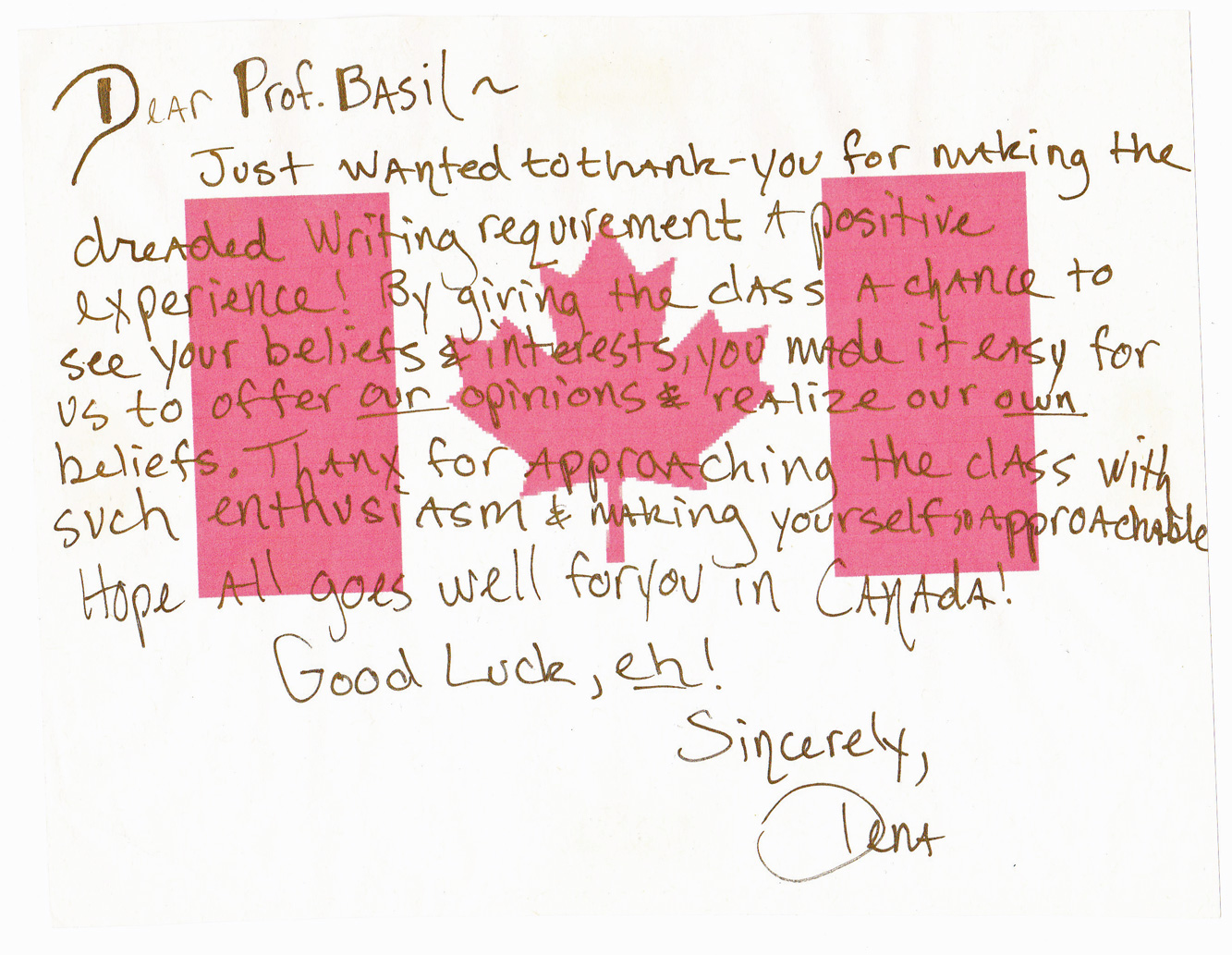
(Originally published April 30, 2011. Beautiful goodbye card by Dena Bowles, Stanford University, 1995)


 RSS - Posts