Archive for publishing
Journalism “bloodbath”
I had a good interview with the Washington Post‘s Sunday magazine a very long time ago. I didn’t get the job, but I learned a ton – and got to walk around that newspaper’s hallowed newsroom a bit. We all revered that newspaper.
Today’s news was expected but is dismaying nonetheless. The oligarchs of America seek to starve its citizens. They are starting with what were established sources of reliable information.
Yuval Noah Harari has said that institutions can take generations to build – establishing trust and proving reliability – but they are nonetheless brittle. Once shattered, we will need to restore them, but is that possible now?
Reposted from NoContest.CA
It was a good day.
I received another royalty cheque yesterday. The textbook Dave Ingre and I wrote has been in print and in continuous use for almost nine years. That’s a long time for a textbook.

My fall classes at University Canada West have been lovely. Going into this week I had been in quite a funk, but my two classes earlier this week revived my spirits. My students rescue the best in me.
Marilyn Suriani
From 2016 (a post called “Big Art”):

“What gets installed in Vegas, stays in Vegas.” My friend photographer Marilyn Suriani is preparing a huge installation there – the largest piece is 54-feet wide. It’s beautiful, a continuation of this remarkable phase in her career, which sees Suriani creating nature- and waterscapes in shimmering, rhapsodic colours. This work feels both abstract and earthly.
—

I learned a couple of weeks ago that Marilyn had passed away, in Atlanta, where she had lived and worked for decades. Marilyn was a Sicilian live-wire originally from Philly whom I truly really loved. I had acquired her photo-book Dancing Naked in the Material World in 1991 or so, in my Buffalo, New York publishing days. We got to know each other over the phone; listening to her voice made the sun shine; and she taught me a ton. At my desk right now, I face seven photographs by Marilyn on the wall.
Hers was the first photogallery published in my old e-zine Ellavon, in 1998 or so. You can find a wider array of her work (scanned and printed at a much higher res) on SurianiPhoto.com.

Certain Days

I admire and have supported this publishing project for many years, as many dear friends who have found the calendar in their Christmas stockings know. To start the year, I go through each page day by day.
The Trotskyist position
I have been immensely delighted to see the resurgence of activity over at The Spartacist and The Workers Vanguard, communist publications I’ve read with passionate interest for more than thirty years. In recent years their pages were filled more and more by obituaries of their original editors, writers, and other comrades. But after a bitter fight within the governing organization regarding responses to the Covid epidemic – the eventually victorious position was to oppose lockdowns as they curtailed and undermined union, organizing, and protest activities – a newly fertile and urgent editorial spirit and ambition have emerged, in North America and across the seas.
Its American-election debriefing ends this way:
In the immediate period, defensive struggles will no doubt be on the order of the day. As the liberals abandon the oppressed groups they claimed to champion—black people, Muslims, trans people, immigrants, women—communists must be in the vanguard of their struggles. But they must seek to build these movements on stronger foundations, away from the moralism and sentimentalism of the liberals and intricately linked to the material interests of all workers. Ultimately, the working class will be the deciding factor. To win its allegiance, communists must show, through the course of class struggle, that unlike the traitors leading them today, they have a program that can materially advance its interests and lead to its liberation.
Apropos
My colleagues and I at The Spectrum – the University at Buffalo’s student newspaper – published a special issue in May 1979 to commemorate the demonstrations and police presence that took over the university at the beginning of that decade. We republished this searing editorial, written by Linda Hanley, from February 1970:

Certain Days …

And apropos:
I admire and have supported this project for many years, as many dear friends who have found the calendar in their Christmas stockings know:
The Certain Days: Freedom for Political Prisoners Calendar collective will be releasing our 24th calendar this coming autumn. We are doing an open call for abolition-related art and article submissions to feature in the calendar, which hangs in more than 6,000 homes, workplaces, prison cells, and community spaces around the world. We encourage contributors to submit both new and existing work. We especially seek submissions from people in prison or jail, so please forward this call to any prison-based artists and writers. Deadline: Friday, May 31, 2024. Send your submissions and brief bio by May 31 to info@certaindays.org.
“A big swing, and it works.”
My friend Kristi Coulter‘s second book, Exit Interview: The Life and Death of My Ambitious Career, gets some love in this week’s New Yorker. Anna Wiener writes,
The jacket copy for “Exit Interview” describes it as “an intimate, surprisingly relatable” story of “a driven woman in a world that loves the idea of female ambition but balks at the reality.” True enough, and Coulter is particularly attuned to sexism in the workplace, including the way women can internalize corporate logic: when she learns, from an exposé in the ‘Times,’ that a colleague was put on probation after having a stillbirth, Coulter finds herself wondering if there was more to the story. “Well, how long post-stillbirth was she off her game? Are we talking three weeks, or three months?” she thinks. When it comes to her own experiences of sexism, she doesn’t spin off into polemics, or belabor the point. For the most part, the microaggressions—and macroaggressions—speak for themselves. …
The book is mostly written in the present tense, adding momentum to workplace conversations about “the checkout pipeline in China,” or the appropriate Web copy for a DVD promotion. One chapter, loosely structured as a travel itinerary, is written in the second person: “Bienvenue à Amazon France, and prepare to be barely tolerated!” Footnotes are sprinkled throughout, adding meta-commentary: “The Leadership Principles are basically Amazon Commandments . . . in the middle of the night I once told my dawdling puppy to show some Bias for Action and pee already so we could go back to bed.” These notes are unobtrusive and clever, but they are also strange: isn’t memoir already a form of meta-commentary? In the final pages, the writing gets cinematic and a little experimental, as Coulter entertains a fantasy while on a run. A big swing, and it works.
I am thrilled by Kristi’s success. I don’t know a better writer.
“Consistent Joy”
Talia Lavin’s Substack blog, The Sword and the Sandwich, is a marvel of multiple focus: the arts (mostly movies and literature), the American “far right,” and … “notable sandwiches.” In my dreams I cannot write as whimsically as she can (and, even when wide awake, rarely as intelligently). This is from her 75th installment on sandwiches, The Grilled Cheese:
In writing about the grilled cheese sandwich, I find myself with little to offer but praise. It is difficult to encounter such a thing and not overrun the page with the fervency of my gladness.
This is not a column where I will carp and complain—about air-fryer grilled cheeses, or fancy gourmet grilled cheeses, or Kraft-single grilled cheeses, or the proper application of butter, or the appropriate pan, or the degree and nature of the condiments. To me, each grilled cheese is enough, and more than enough. In this world so full of slaughter and fire, where doubt and monstrosity abound, this much is clear to me: the grilled cheese is a small and perfect thing. And how many of those are there?
So my position on the grilled cheese is unabashedly boosterish, and moreover, it is agnostic towards ingredients and provenance. To your grilled cheese you may add caramelized onions or avocado; bacon, turkey or ham; chutney or cornichons. Make it with Wonderbread or a freshly-baked eighteen-grain country loaf sourced from fields you cultivated yourself in a cantilevered sky-farm with the finest hydroponics. Add goat cheese or smoked gouda or aged cheddar or unidentified plasticine processed cheese product; heat it in a pan or over a flame, under a broiler, in a dutch oven, or with an acetylene torch. I do not care. You have composed something perfect with your own hands. You have made something that will warm and satisfy you. You have, for a small moment, partaken of the act of creation that grants the human animal its sliver of divinity. You have done so by means of the grilled cheese sandwich.
From two perfect things—bread and cheese—arises a more perfect union. …
I am hungry for joy lately. Perhaps you are too. The grilled cheese sandwich for me is an object of consistent joy, which is different in kind than the transcendent ray-through-the-clouds joy that graces any life too rarely. Perhaps that makes it more valuable; reliable pleasure, ordinary pleasure, is as common as light and as necessary. It is only in the consideration of it that I come to appreciate how this mundane thing can be an object of desire and delight. With effort and after much contemplation I think myself toward joy, and welcome its arrival. Life must be leavened by joy to rise; stand and let it in; it approaches with soft footfalls and is easy to miss, or to begrudge in petulance or fervor. …
“Farewell to a Poor Bastard”

This 1995 photograph is from the book Drawn & Quarterly: Twenty-Five Years of Contemporary Cartooning, Comics, and Graphic Novels. It depicts five comics artists who founded a new era and style of autobiographical narrative: Adrian Tomine, Julie Doucet, Chester Brown, Seth, and Joe Matt. After I purchased this wonderful book and first saw this photograph, I could have fainted. I have just about everything each of them has ever published. Each of these artists has altered how I regard literature, art, and life.
Joe Matt is the fellow on the right. He seemed to disappear a few years ago, to the point that his books were no longer available from Drawn & Quarterly. I asked one of the owners of Olympia, Washington’s Danger Room Comics (you must go there!) what was going on with Joe Matt, and he told me that Seth (second from right, above) stays in touch with him; this seemed to me a courteous and circumspect way to indicate that Matt was not doing well.
It was impossible to love Joe Matt without also being intensely exasperated by him. The love and exasperation weren’t in tension but fed off each other: Caring for him was inextricable from irritation at the myriad ways he exercised his gift for self-sabotage. …
The cartoon Joe Matt was a cheapskate, lazy, shallow, and, worst of all, a swinish boyfriend who neglected his flesh-and-blood partners in preference to chronic masturbation to pornography and fantasizing about other women.
This self-portrait of the artist as a young jerkoff earned Joe an intense cult following who marveled at his gift for self-revelation as well as his impeccable comic timing. The real Joe shared many traits with his cartoon alter ego—but also a warmth that won him many friends. …
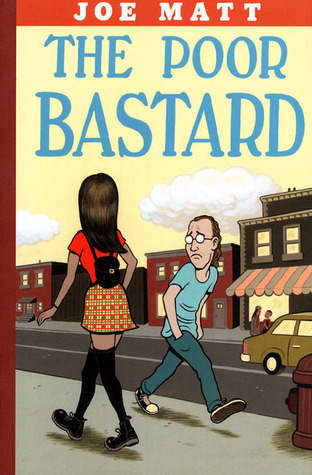
I got to know Joe Matt while I was working as a journalist in Toronto in the 1990s. I would occasionally write about Joe’s work and also that of his two cartoonist friends Chester Brown and Seth (who sometimes showed up as comic foils in Joe’s work). I had shown my wife, Robin Ganev, Joe’s just published graphic novel, The Poor Bastard. Robin delighted in the book as an accurate portrayal of the dating scene among young Toronto bohemians in the 1990s. Joe’s portrait of himself as a heel impressed her as an essentially accurate rendering of an all-too-common male type. As my friend the journalist Nathalie Atkinson notes, “Many women love Joe Matt’s comics—in part because he confirms everything we suspected.” Despite enjoying the work, Robin wasn’t quite sure she wanted to meet Joe in the flesh. Like Jacqueline Susann after reading Philip Roth’s masturbatory masterpiece Portnoy’s Complaint (1969), Robin admired the work but was reluctant to shake the hand.
As it happened, when she met him, Robin took to Joe immediately. He was witty, self-deprecating, a responsive listener, and disarmingly willing to share personal information.
—
September 27: The Comics Journal has published a series of reminiscences by Joe Matt’s cartoonist colleagues. They are all really good, but the piece by Seth had me in tears by the time I got to the end of it, so rich is it with memory and conflicting emotions, admiration and love side by side with disdain and disapproval. It’s art.
—
Glionna from Italy


My friend John Glionna has been spending the summer in his ancestors’ home town in Italy, working on a book about the people there. One of the joys of this writer is the way he lets us see rough drafts of the book’s chapters emerge on his terrific blog. His “Pomarica Journal” is dazzling, vivid with the voices of others and with Glionna’s profound friendliness (and a customary goof or two). His photographs are really terrific, too.
(I’ve asked John to create a dedicated photo-gallery on his website. We’ll see what happens!)
My favourite Trotskyists are back strong
The folk at The International Communist League (Fourth Internationalist) have been publishing two of my favourite radical periodicals, The Worker’s Vanguard and The Spartacist, for decades. I have probably learned more per sentence from these publications than from any other.
The organization’s output slowed to a drip during the pandemic, and I feared that the generations that had kept it going for so long were leaving or dying off; indeed, obituaries were filling the Vanguard. What in fact was happening was not a demise, though, but a debate. These Trotskyists were arguing among themselves about covid lockdowns and governmental restrictions on large gatherings, both of which they originally supported. A growing faction, however, began to see these lockdowns and restrictions as impediments to protest and communist organizing, impediments that undermined class consciousness and supported capitalist exploitation. The growing faction was victorious.
And the group started publishing its erudite propaganda again, at its former, prolific rate. Pick up their publications at your favourite radical bookstore! The Workers Vanguard is still just fifty cents.

Learning or remembering?
My “Usage Tip of the Day” from the great Bryan Garner:

I would like to say I already knew this one. It is pretty to think so, at any rate.
—
My partner gave me Bryan Garner’s Modern English Usage for Christmas (it’s terrific, and right beside me as I type).
Workers Vanguard

My favourite Trotskyists are back with a new issue of The Spartacist. I was afraid that the International Communist League (Fourth Internationalist), which publishes that periodical as well as the newspaper Workers Vanguard, had ceased operations. No doubt its leadership is getting old; indeed, this issue of The Spartacist has three obituaries of former leading members.
I value these publications for their erudite, brilliantly written propaganda (their word), which has come in handy for me any number of times. I met a couple of their editors back at Stanford University in the mid-nineties, and featured an issue from their Women and Revolution series in my “Writing and the Bill of Rights” classes there.
I hope a younger generation of true Marxist-Leninists takes up the banner. I will miss this voice terribly otherwise.
An editor’s help

An autumn evening, 1979: I was visiting the office of my university’s student newspaper to say hello to my colleagues. Joe Simon, the managing editor, was there. He told me he liked this week’s “Phaedrus,” my regular column, scheduled to appear the next morning. “I changed one word,” he said. “You said a woman’s lips were chartreuse.” Joe had a dictionary on his desk, open to C. I looked. “I trust you meant ‘ruby red.'”
I sure did.



 RSS - Posts